
Ācārya Sthaneshwar Timalsina
Principal depositario del linaje Sarvāmnāya fuera de Nepal, investigador y fundador de Vimarsha Foundation.
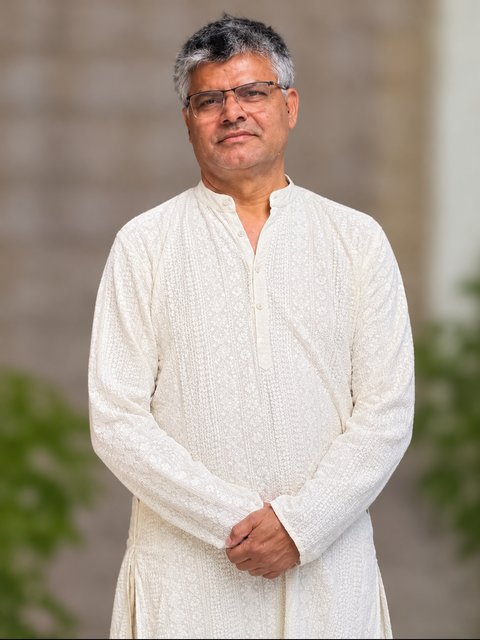
Ācārya Sthaneshwar Timalsina une en su persona dos mundos que rara vez coinciden, el de la transmisión tradicional de maestro a discípulo y el de la investigación universitaria, y ambos se reflejan en una obra que estudia la filosofía india tanto desde sus textos como desde su práctica.
Es titular de la cátedra Nirmal K. y Augustina Mattoo de Humanidades Índicas Clásicas en el Departamento de Estudios Asiáticos y Asiático-Americanos de la Stony Brook University (Nueva York). En 2019 fundó Vimarsha Foundation, concebida como un gurukula global para el estudio de los sistemas filosóficos y contemplativos de la India.
Formación tradicional
Se crio en el gurukula védico de su padre en Nepal. Durante catorce años recibió de Svāmī Premchetan Brahmacārī la transmisión completa del Sarvāmnāya, y estudió la obra de Abhinavagupta con maestros de Varanasi vinculados a Gopīnāth Kavirāj. En 1996 recibió la consagración como ācārya (ācārya abhiṣeka) y fue reconocido como Śaivācārya de la orden nepalí Sarvāmnāya. La genealogía completa de este linaje puede consultarse en nuestro blog.
Trayectoria académica
Cursó estudios de máster en la Sampurnananda Sanskrit University de Varanasi (1991) y enseñó durante varios años en la Nepal Sanskrit University de Katmandú, donde impulsó un departamento dedicado al estudio de las tradiciones de los Āgama. Mientras preparaba su tesis doctoral enseñó en la University of California, Santa Barbara, y en la Washington University in St. Louis.
Se doctoró en 2005 en la Universidad Martín Lutero de Halle-Wittenberg (Alemania) con una investigación sobre la historia del Advaita Vedānta. Ese mismo año se incorporó a la San Diego State University, donde enseñó durante casi dos décadas en los departamentos de Estudios de las Religiones y de Filosofía, antes de ocupar su actual cátedra en Stony Brook.
Investigación
Su investigación abarca el Advaita Vedānta y los estudios sobre la conciencia, las filosofías Śaiva-Śākta de las corrientes Kaula y Krama, las teorías indias de la mente (reconocimiento, memoria, imaginación y emoción), la visualización contemplativa y la cultura visual, los estudios sobre yoga y la filosofía comparada. Es autor de cuatro monografías y de más de ochenta artículos y capítulos de libro, y escribe también obras originales en sánscrito.
Libros
- Tantric Visual Culture: A Cognitive Approach. Londres, Routledge, 2015.Un estudio de las imágenes contemplativas de la India desde las ciencias cognitivas.
- Language of Images: Visualization and Meaning in Tantras. Nueva York, Peter Lang, 2015.Sobre la visualización meditativa y su significado en la literatura de los Āgama.
- Consciousness in Indian Philosophy: The Advaita Doctrine of “Awareness Only”. Londres, Routledge, 2008.La doctrina advaita según la cual solo existe la conciencia.
- Seeing and Appearance: A History of the Advaita Doctrine of Dṛṣṭisṛṣṭi. Aquisgrán, Shaker Verlag, 2006.Basado en su tesis doctoral, sobre la doctrina advaita según la cual la percepción crea lo percibido.
Obras en sánscrito
- Śivabodhaviṃśikā. Nueva York, Vimarsha Foundation, 2025.
- Amṛtādistava. San Diego, Vimarsha Foundation, 2021.
- Saṃvartastava. San Diego, Vimarsha Foundation, 2021.
- Entre sus composiciones figuran también el Cāmuṇḍāśataka y el Tantragahvara.
Publicaciones
Artículos (32)
- “God, Īśvara, and the Brahman: A Case for a Post-Perennial Comparative Theology”, Sophia 63 (2024): 401–417.
- “Emergence, Panpsychism, and Manifestation (Abhivyakti)”, The Journal of Hindu Studies (2024).
- “Change: Thinking Through Sāṅkhya”, Religions 13 (2022): 549.
- “Language of Gestures: Mudrā, Mirror, and Meaning in Śākta Philosophy”, Religions 12 (2021): 211.
- “Rasāsvāda: A Comparative Approach to Emotion and the Self”, Journal of Indian Philosophy and Religion 26 (2021): 114–139.
- “Can Representation Be Transformative? Resemblance, Suggestion, and Metaphor in Tantric Meditation”, Philosophy East and West 71:1 (2021): 193–216.
- “Aham, Subjectivity, and the Ego: Re-engaging Abhinavagupta”, Journal of Indian Philosophy 48:4 (2020): 767–789.
- “Bhartṛhari and the Daoists on Paradoxical Statements”, Journal of Indian Philosophy and Religion 23:4 (2018): 5–20.
- “Puruṣavāda: A Pre-Śaṅkara Monistic Philosophy as Critiqued by Mallavādin”, Journal of Indian Philosophy 45:5 (2017): 939–959.
- “Śrīharṣa on Knowledge and Justification”, Journal of Indian Philosophy 45:2 (2017): 313–329.
- “The Monistic Śākta Philosophy in the Guhyopaniṣad”, Zeitschrift für Indologie und Südasienstudien 34 (2017): 247–258.
- “A Cognitive Approach to Tantric Language”, Religions 7:12 (2016).
- “Theatrics of Emotion: Self-deception and Self-cultivation in Abhinavagupta’s Aesthetics”, Philosophy East and West 66:1 (2016): 104–121.
- “The Dialogical Manifestation of Reality in Āgamas”, Journal of Hindu Studies 7:1 (2014): 6–24.
- “Indigenous Epistemology and Placing the Cultural Self in Crisis: New Hermeneutic Model for Cultural Studies”, SERAS 36 (2014): 6–29.
- “Text as the Metaphoric Body: Incorporation of Tripurā in Saundaryalaharī”, Zeitschrift für Indologie und Südasienstudien 31 (2014): 1–32.
- “Gauḍapāda on Imagination”, Journal of Indian Philosophy 41:6 (2013): 591–602.
- “Imagining Reality: Image and Visualization in Classical Hinduism”, SERAS (2013): 50–69.
- “Contemplating upon the Image of Bhairava: A Study of Kṣemarāja’s Bhairavānukaraṇastava”, Journal of Indian Research 1 (2013): 142–152.
- “Holographic Bodies and Metaphoric Limbs in Hindu Myths”, Zeitschrift für Indologie und Südasienstudien 2 (2012): 167–186.
- “Embodiment and Self-realisation: The Interface between Śaṅkara’s Transcendentalism and Shamanic and Tantric Experiences”, Journal of Hindu Studies 5:3 (2012): 1–15.
- “Reconstructing the Tantric Body: Elements of the Symbolism of Body in the Monistic Kaula and Trika Tantric Traditions”, International Journal of Hindu Studies 16:1 (2012): 57–91.
- “Body, Self, and Healing in Tantric Ritual Paradigm”, Journal of Hindu Studies 5:1 (2012): 30–52.
- “Materializing Space and Time in Tantric Images”, Zeitschrift für Indologie und Südasienstudien 28 (2011): 145–182.
- “Encountering the Other: Tantra in the Cross-cultural Context”, Journal of Hindu Studies 4:3 (2011): 274–289.
- “Songs of Transformation: Vernacular Josmanī Literature and the Yoga of Cosmic Awareness”, International Journal of Hindu Studies 14:2–3 (2010): 201–228.
- “The Brahman and the Word Principle (Śabda): Influence of the Philosophy of Bhartṛhari on Maṇḍana’s Brahmasiddhi”, Journal of Indian Philosophy 37 (2009): 189–206.
- “Bhartṛhari and Maṇḍana on Avidyā”, Journal of Indian Philosophy 37 (2009): 367–382.
- “Ritual, Reality, and Meaning: The Vedic Ritual of Cremating a Surrogate Body”, Zeitschrift der Deutschen Morgenländischen Gesellschaft 159:1 (2009): 45–69.
- “Cosmic Awareness and Yogic Absorption in the Nāth Literature”, Studien zur Indologie und Iranistik 25 (2008): 137–168.
- “Metaphors, Rasa, and Dhvani: Suggested Meaning in Tantric Esotericism”, Method and Theory in the Study of Religion 19:1–2 (2007): 134–162.
- “Terrifying Beauty: Interplay of Sanskritic and Vernacular Rituals of Siddhilakṣmī”, International Journal of Hindu Studies 10 (2006): 59–73.
Capítulos de libro (20)
- “Cosmic Process, Philosophy, and Soteriology in the Works of Abhinavagupta”, en Oxford Handbook of Tantric Studies, ed. Payne y Hayes (Oxford University Press, 2022, 177–195).
- “Attention, Memory, and the Imagination”, en Oxford Handbook of Tantric Studies, ed. Payne y Hayes (Oxford University Press, 2022).
- “The Phenomenology of Meditation: An Advaita Approach”, en Routledge Handbook on the Philosophy of Meditation, ed. Repetti (Routledge, 2022, 313–326).
- “Savoring Rasa: Emotion, Judgment, and Phenomenal Content”, en Emotions in Classical Indian Philosophy, ed. Heim, Ram-Prasad y Tzohar (Bloomsbury, 2021, 255–276).
- “Reason, Dharma, and the Discovery of Faith: Insights from the Modes of Classical Hinduism”, en Routledge Handbook of South Asian Religions, ed. Jacobsen (Routledge, 2020).
- “Abhinavagupta on Śānta Rasa: The Logic of Emotional Repose”, en Handbook of Logical Thought in India, ed. Sarukkai (Springer, 2020).
- “Dialogue and Culture: Reflections on the Parameters of Cultural Dialogue”, en The Cambridge Handbook of Intercultural Training, ed. Landis y Bhawuk (Cambridge University Press, 2020, 658–679).
- “Meditation and Imagination”, en The Cambridge Handbook of the Imagination, ed. Abraham (Cambridge University Press, 2020, 783–795).
- “Embodied Experience in the Mahārthamañjarī of Maheśvarānanda”, en Transformational Embodiment in Asian Religions, ed. Pati y Zubko (Routledge, 2020, 128–144).
- “Relativism in Indian Traditions: Examining the Viewpoints”, en The Routledge Handbook of the Philosophy of Relativism, ed. Kusch (Routledge, 2019, 11–19).
- “Semantics of Nothingness: Bhartṛhari’s Philosophy of Negation”, en Nothingness in Asian Philosophy, ed. Liu y Berger (Routledge, 2014, 25–43).
- “Self, Causation, and Agency in the Advaita of Śaṅkara”, en Free Will, Agency, and Selfhood in Indian Philosophy, ed. Dasti y Bryant (Oxford University Press, 2014, 186–209).
- “The Concept of Ābhāsa in the Yogavāsiṣṭha”, en Mind, Morals, and Make-Believe in the Mokṣopāya (Yogavāsiṣṭha), ed. Chapple y Chakrabarti (SUNY Press, 2014, 53–78).
- “Vasiṣṭha and Borges: In Quest of Enlightenment”, en Mind, Morals, and Make-Believe in the Mokṣopāya (Yogavāsiṣṭha), ed. Chapple y Chakrabarti (SUNY Press, 2014, 119–140).
- “Linguistic and Cosmic Powers: The Concept of Śakti in the Philosophies of Bhartṛhari and Abhinavagupta”, en Classical and Contemporary Issues in Indian Studies, ed. Duquette y Kumar (D. K. Printworld, 2013, 211–232).
- “The Yoga System of the Josmanīs”, en Yoga in Practice, ed. White (Princeton University Press, 2012, 309–324).
- “Liberation and Immortality: Bhuśuṇḍa’s Yoga of Prāṇa in the Yogavāsiṣṭha”, en Yoga Powers, ed. Jacobsen (Brill, 2012, 303–326).
- “The Body of the Goddess: Eco-awareness and Embodiment in Hindu Myth and Romance”, en Constant and Changing Faces of the Goddess, ed. Simkhada y Hermann (2008, 273–289).
- “Meditating Mantras: Meaning and Visualization in Tantric Literature”, en Theory and Practice of Yoga, ed. Jacobsen (Brill, 2005, 213–236).
- “Time and Space in Tantric Art”, en Nepal: Old Images, New Insights, ed. Pal (Marg Publications, 2004, 20–35).
Otros escritos
- “Visualization in Hindu Practice”, Oxford Research Encyclopedia of Religion (2017).
- “Mantra” y “Śakti”, Brill’s Encyclopedia of Hinduism, vol. 2, ed. Jacobsen (Brill, 2010).
- “Mantra: Sound of the Infinite” y “Tantra and the West”, Sutra Journal 1:1–2 (2015).
- Editor de los números monográficos de Religions “Cognitive Science and the Study of Yoga Tantra” (2017) y “Society of Tantric Studies Conference Proceedings” (2020).
Primeros escritos (1990–1998)
Entre 1990 y 1998 publicó en revistas de Katmandú y Varanasi, en sánscrito y nepalí, sus primeros trabajos sobre el Krama, la Śrīvidyā, el ritual y el Advaita.
- “Sakalāgamamantravidyāvatārakā pañcabrahmamantrāḥ”, Maryādā (1998): 26–37.
- “Bhairavādvaitavāda”, Parimārjana 5:7 (1998): 12–16.
- “Foundation of Dṛṣṭisṛṣṭivāda”, Ṛtambharā 2:3 (1997): 114–120.
- “Mahātripurasundarīcarcā”, Vaidyanātha Kṣetra 4:4 (1996): 23–50.
- “Pūjā-rahasya”, Paśupati Kṣetra 2:6 (1995): 8–13, y 3:7 (1996): 19–22.
- “Ātma-pūjā”, Paśupati Kṣetra 2:1 (1995): 21–25.
- “Krama-vimarśa”, Aruṇodaya 26:1–2 (1990): 1–18.
Fuentes
- Vimarsha Foundation
- Lista completa de publicaciones (Vimarsha Foundation)
- Perfil en la Stony Brook University
Información recopilada de Vimarsha Foundation, Stony Brook University y San Diego State University.